


Calves are the lifeblood of the cow-calf operation; they are the steady source of income that runs through the veins of this farming business. Maximizing the value of calves will inevitably lead to greater returns for the operation.
Backgrounding has been defined as the extension of the phase where the calf is still growing before it enters a phase where energy-dense rations are fed. Calves can be backgrounded on either grazing or within pens. In both instances, the aim is to maximize the use of roughages, provide minimal quantities of supplements and add value to the calf. Backgrounded calves usually fall in the weight range of 180-220kg. Typically, the growth rate of these calves is restricted (with a desired ADG of less than 1kg), to prevent fat deposition and ensure proper frame (skeletal) and muscle development. The key is that backgrounded calves should maintain a constant upward growth curve. What is developed during the backgrounding phase essentially becomes the foundation which supports performace during the feedlot period. Backgrounding calves also allows the producer the opportunity to market the calf when there is a greater demand (prices are more favorable for sale). In an economic environment where there is a low carcass price and a high feed (maize) price, it is not economically beneficial for the feedlots to buy calves, hence creating an opportunity for the producer to retain their calves and background them, given that enough forage is available to maintain the requirements of the calves. Backgrounding aims to provide minimal supplements for optimal growth; hence the maximum intake of any supplement should be 1.2% of body weight, otherwise, calves will start substituting the grazing with the background supplement. Backgrounding supplements should contain sufficient quantities of bypass protein to support skeletal and muscle growth and development.
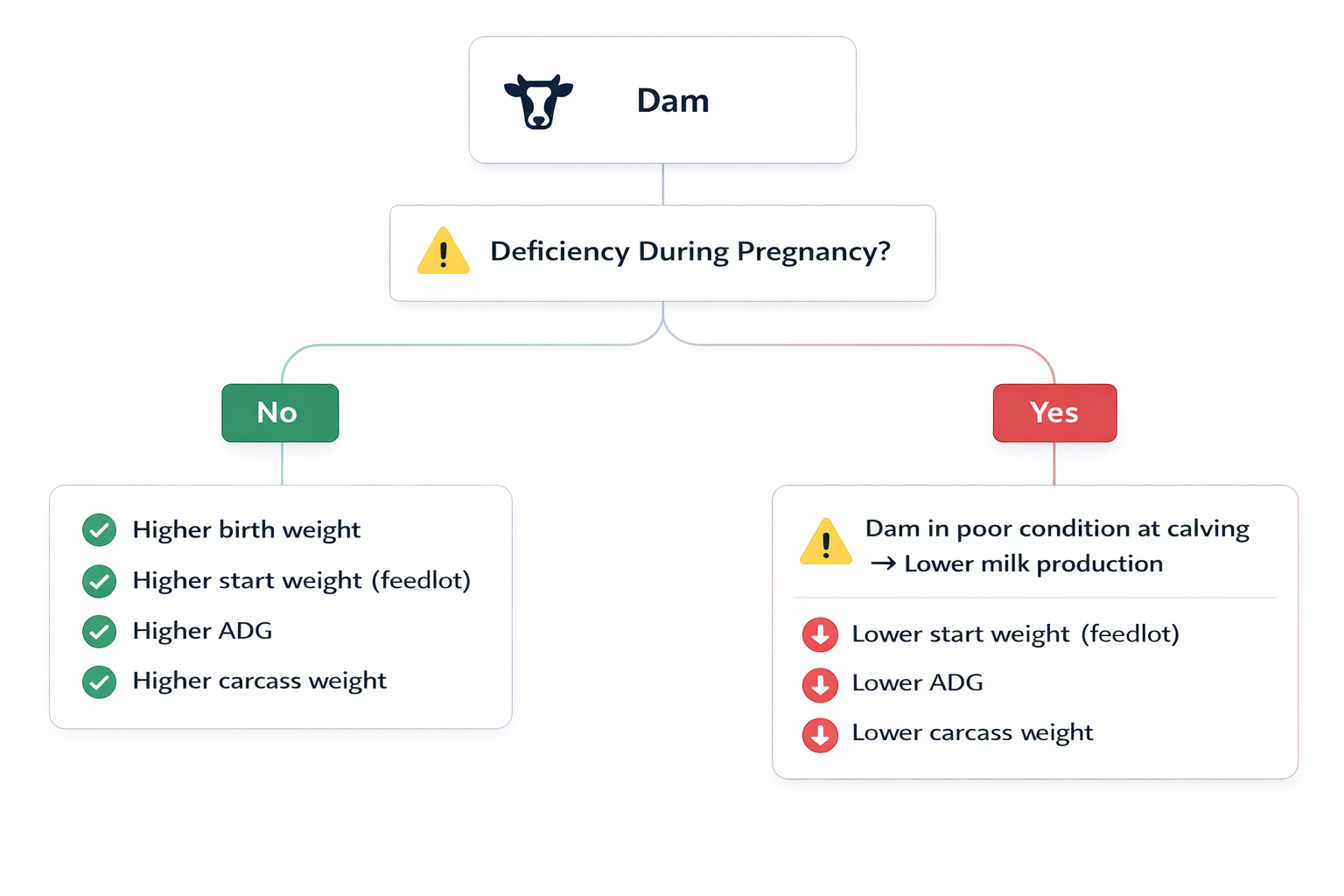
Some factors are going to influence the performance of a backgrounded calf. Before weaning, the calf will have an inherent genetic potential for growth (which comes from its parents), its health status (colostrum quantity and quality received at birth), and the nutrition of the dam. After weaning, the calf’s performance is going to be influenced by its body weight, energy intake, the period when energy intake occurs (age and type of environmental conditions), and the type of energy source used (maize, wheat, barley, etc.).
From the diagram below, it is evident that the cow (and her nutrition) plays a critical role in the future performance of the backgrounded calf. Deficiencies of the dam before the calf’s birth will result in reduced performance of the calf later on.
Backgrounding on dry grazing
The dry grazing in the Northern and Eastern parts of South Africa is unanimous with winter. Lower temperatures lead to more energy being expended by cattle to keep warm. Characteristically, calves grow less (have lower ADG values, roughly 500-700g/day depending on supplement characteristics, grazing, etc.) when on dry grazing compared to green grazing. This is attributed to the quality of the grass, which is low in protein (<4%) and has a lower digestibility (mature standing hay) value. As the digestibility of the grazing decreases, the proportion of intake as a percentage of body weight (1.4-1.7% of BW for young cattle) also decreases. Hence a greater amount of supplementation is required to stimulate growth on dry grazing.
* Important to note
When backgrounding calves on either green or dry grazing: camps should not be too large, as calves will expend energy which could be directed toward growth, for walking activity.
Backgrounding on green grazing
When grazing is green and lush, it is indicative of a higher protein content (as the grass is in its growing phase) and its digestibility is greater. This allows the producer to realize greater average daily gains (800g-1200g/day) with lower rates of supplementation. Green grazing intake by calves is subsequently also higher (2.4-2.7% of BW intake) and less energy is resultantly expended on temperature regulation, although heat stress may play a role on extremely hot days.
The table below shows suitable supplements which can be used to background calves on different grazing types.
Table 1: Supplementation options on different grazing types
| Grazing type | Product | Intake of supplement | Expected ADG (kg/d) |
| Fertilized, green pastures | Voermol Molovite (V7266) | 0.8 – 1.2 kg/calf/d | 1 – 1.2 |
| Unfertilized, green grazing | Voermol Supermol (V7267) | 0.8 – 1.2 kg/calf/d | 0.8 – 1.2 |
| Dry grazing | Voermol Production Lick (V10108) | 1.2 – 1.5 kg/calf/d | 0.6 – 1 |
| Home mixing option | Voermol SB100 (V4498): 200kg
Voermol Procon 33 (V12701): 50kg Maize meal/Hominy chop: 750kg Total 1000kg |
1-1.2% of BW | 0.6 – 1.2 (depending on grazing & supplementation rate) |
The advantage of backgrounded calves
Calves that are backgrounded adapt easier in the feedlot environment as they are used to feed. It is additionally evident that a decrease in feed intake does not take place, compared to calves that have received no supplementation. Backgrounded calves also have lower morbidity and mortality rates, and usually, perform better in the feedlot (have higher ADG and lower FCR values) and experience lower levels of stress than calves which have not been backgrounded.


